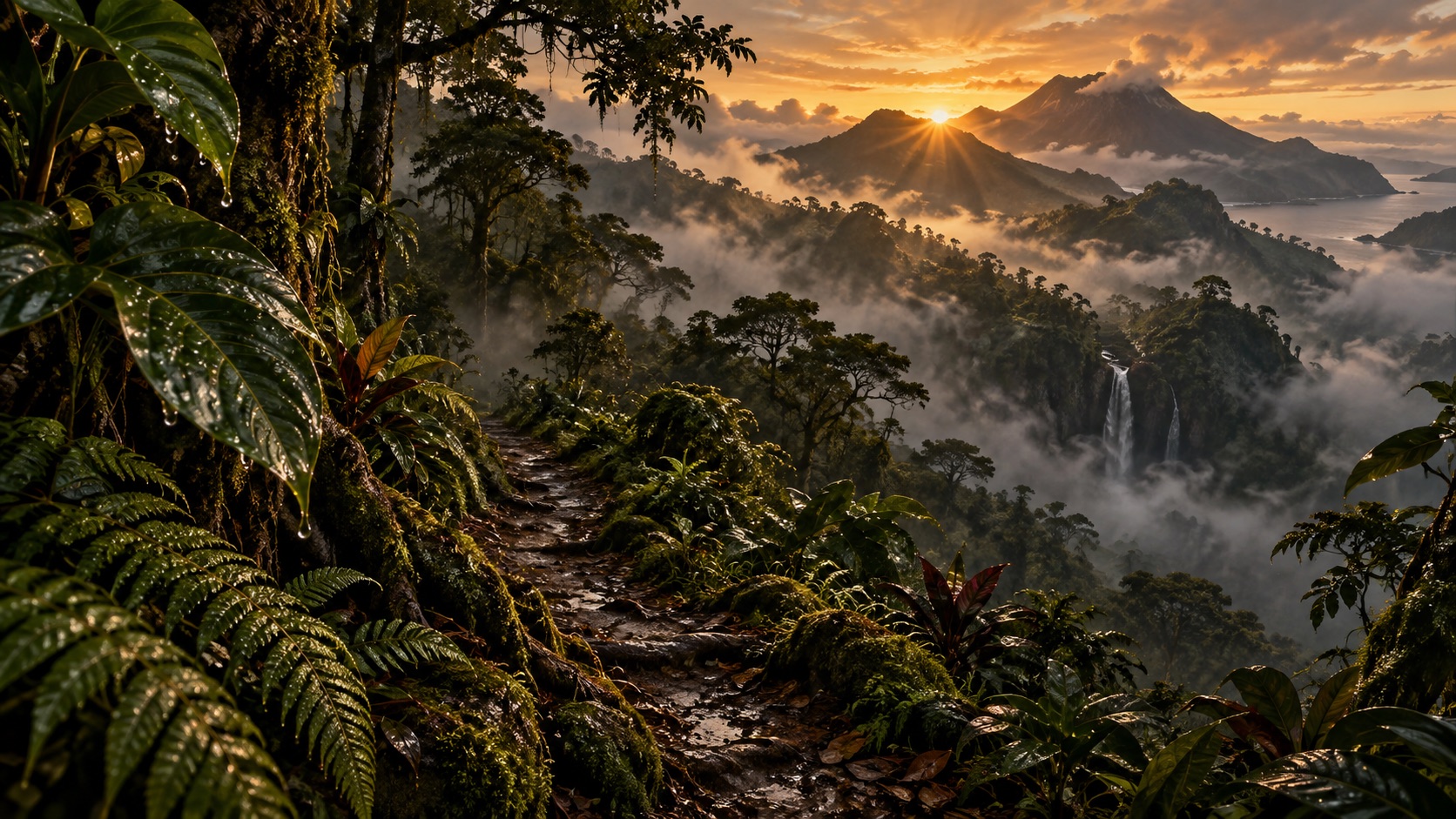
Ahiʻkoa and its forest are invented. The way a leaf catches a drop of water is real.
FIELD NOTE 01 · FOG WATER
The forest drinks the fog.
Stand under a tree in the rain and you can hear water on the leaves. In a cloud forest, the weather can be quieter. A bank of cloud moves through the canopy. Tiny droplets meet leaves, branches, moss, and bark. They join into larger drops, then fall to the ground. Scientists call this cloud-water interception.
That water may never register in a rain gauge set out in the open. The gauge measures what falls from the sky. It cannot measure everything the forest gathers from a passing cloud. Beneath the canopy, the ground can get wet on a day that hardly looks rainy at all.
How much water arrives this way depends on the place, season, weather, and shape of the forest. In one U.S. Geological Survey study at sites across Oʻahu, Maui, and Hawaiʻi Island, cloud-water interception accounted for between 3% and 34% of total water input. There is no single number that fits every cloud forest.
That is the physical idea behind Marisol’s work in Rootbound. She can count rain, watch the canopy, and ask what water reaches the roots. On fictional Ahiʻkoa, the late rain makes those questions urgent. A forest can be losing water before its loss is obvious from a distant view.
Further reading: U.S. Geological Survey, “Cloud-water interception in Hawaiʻi”.
FIELD NOTE 02 · ʻŌHIʻA
A clean pair of boots.
The ʻōhiʻa is a real Hawaiian tree. Ahiʻkoa’s forest is fictional, but its author’s note points to a real threat: Rapid ʻŌhiʻa Death. The disease is caused by fungi that can enter through a wound and block the movement of water within the tree. There is currently no cure for an infected tree.
That makes a small action before a forest walk matter. Soil and plant material can cling to boots, tools, and tires. Hawaiʻi’s Department of Land and Natural Resources asks visitors to clean their gear before and after entering forests, avoid injuring ʻōhiʻa, and leave ʻōhiʻa wood and plant parts where they are. The aim is to reduce the chance of carrying the fungi to another place.
Marisol comes to Ahiʻkoa wanting to find a plant. Her training teaches her to look closely at what she collects. The real-world lesson is less dramatic than a discovery: when we leave a forest, what have we picked up without noticing?
If you visit a Hawaiian forest, follow current local guidance. Brush soil and debris from your footwear and gear, and check the state’s advice for cleaning them properly. It is a modest act. It gives a living tree one less risk to face.
Current guidance: Hawaiʻi Invasive Species Council, “Rapid ʻŌhiʻa Death”.